
Meta Will Start Charging ~Rp356 for WhatsApp Replies. Here’s How Your Sales Team — and CRM — Should Adapt
Starting 1 October 2026, the cost of using WhatsApp for sales and customer engagement will change significantly.
For businesses in Indonesia, Meta's new service-message rate is about Rp356.65 per delivered message on the WhatsApp Business Platform.
For a small business, that may not sound like much. But for a company sending tens or hundreds of thousands of replies every month, it can quickly become a real operating cost.
Example: 100,000 chargeable service messages:
100,000 × Rp356.65 = Rp35.6 million per month
The solution is not:
"Tell salespeople to send fewer messages."
"Move customers away from WhatsApp."
WhatsApp remains one of the most important customer communication channels in Indonesia. The better strategy is to use the right WhatsApp channel at the right stage of the sales journey, and adapt your CRM so the entire customer journey stays connected.
First: Calculate Your Real Additional WhatsApp Cost
Not every WhatsApp reply costs Rp356.65. Before estimating your extra cost, businesses should account for two free mechanisms first.
1. 1,000 Free Service Messages Per Number Every Month
Each WhatsApp Business Platform number gets 1,000 free service messages per month. With 5 numbers:
5 × 1,000 = 5,000 free service messages per month
This allowance applies to service messages and resets every month.
2. The 72-Hour CTWA Free Entry Point
Click-to-WhatsApp Ads become even more valuable under this new pricing model. When an eligible customer enters through a Click-to-WhatsApp Ad or Facebook CTA and the business responds in time, Meta opens a 72-Hour Free Entry Point — messages sent during this window can stay free from Meta's delivery charge.
So don't just calculate cost as:
Total WhatsApp messages × Rp356
A better formula:
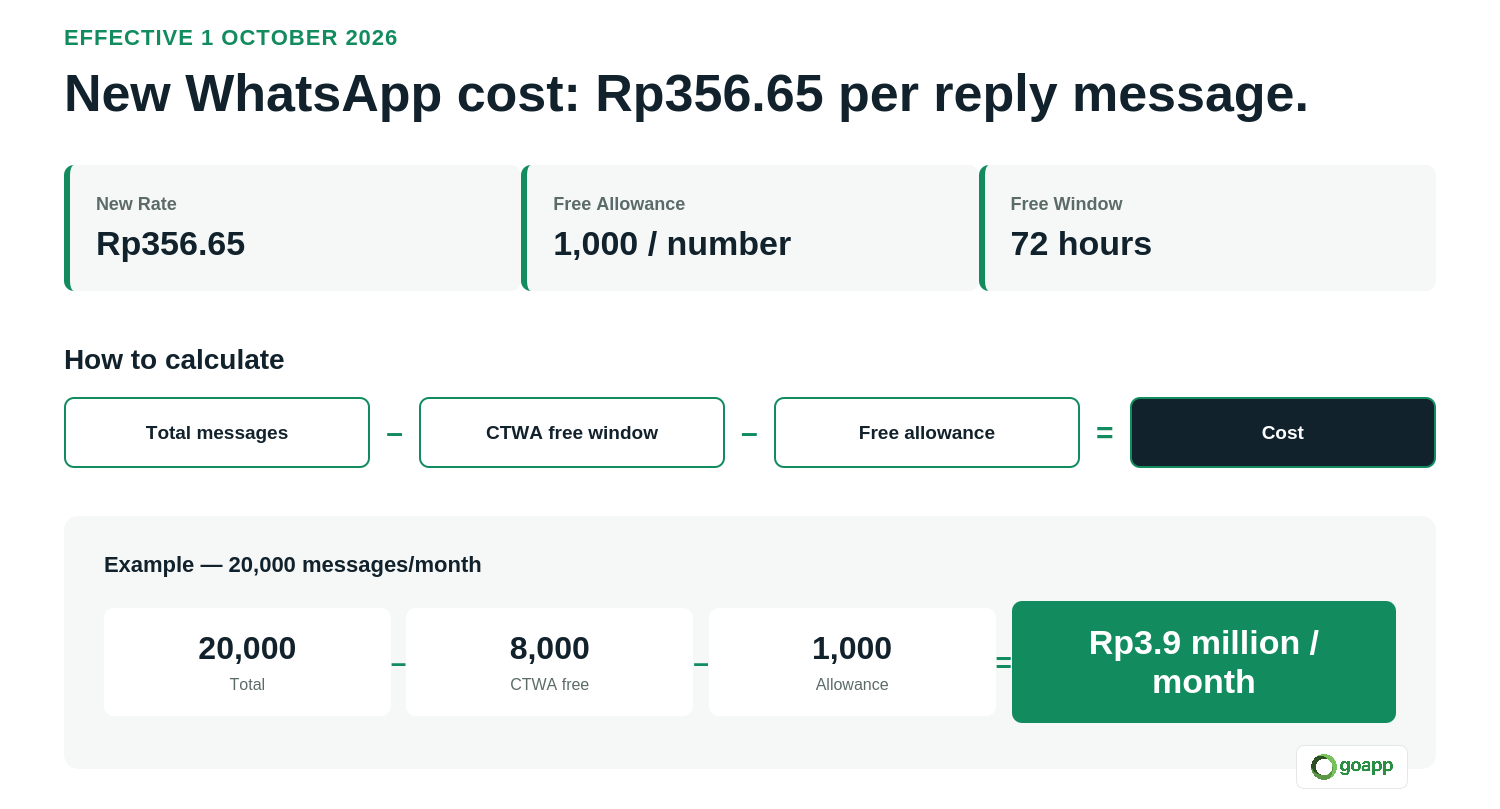
Total service messages − Messages sent during CTWA 72-hour Free Entry Points − 1,000 free service messages per number = Chargeable service messages
Then: Chargeable messages × Rp356.65
Example
One Official WhatsApp number sends 20,000 service messages a month.
8,000 of those are sent during eligible CTWA free windows → leaves 12,000
Subtract the monthly free allowance → 12,000 − 1,000 = 11,000 chargeable messages
Estimated additional Meta cost:
11,000 × Rp356.65 = Rp3,923,150 per month
Without considering the free mechanisms, someone might wrongly estimate:
20,000 × Rp356.65 = Rp7,133,000
That's a major difference. For businesses processing hundreds of thousands of WhatsApp messages, how the sales journey is designed starts to matter a lot.
Don't Abandon WhatsApp. Redesign the Sales Journey.
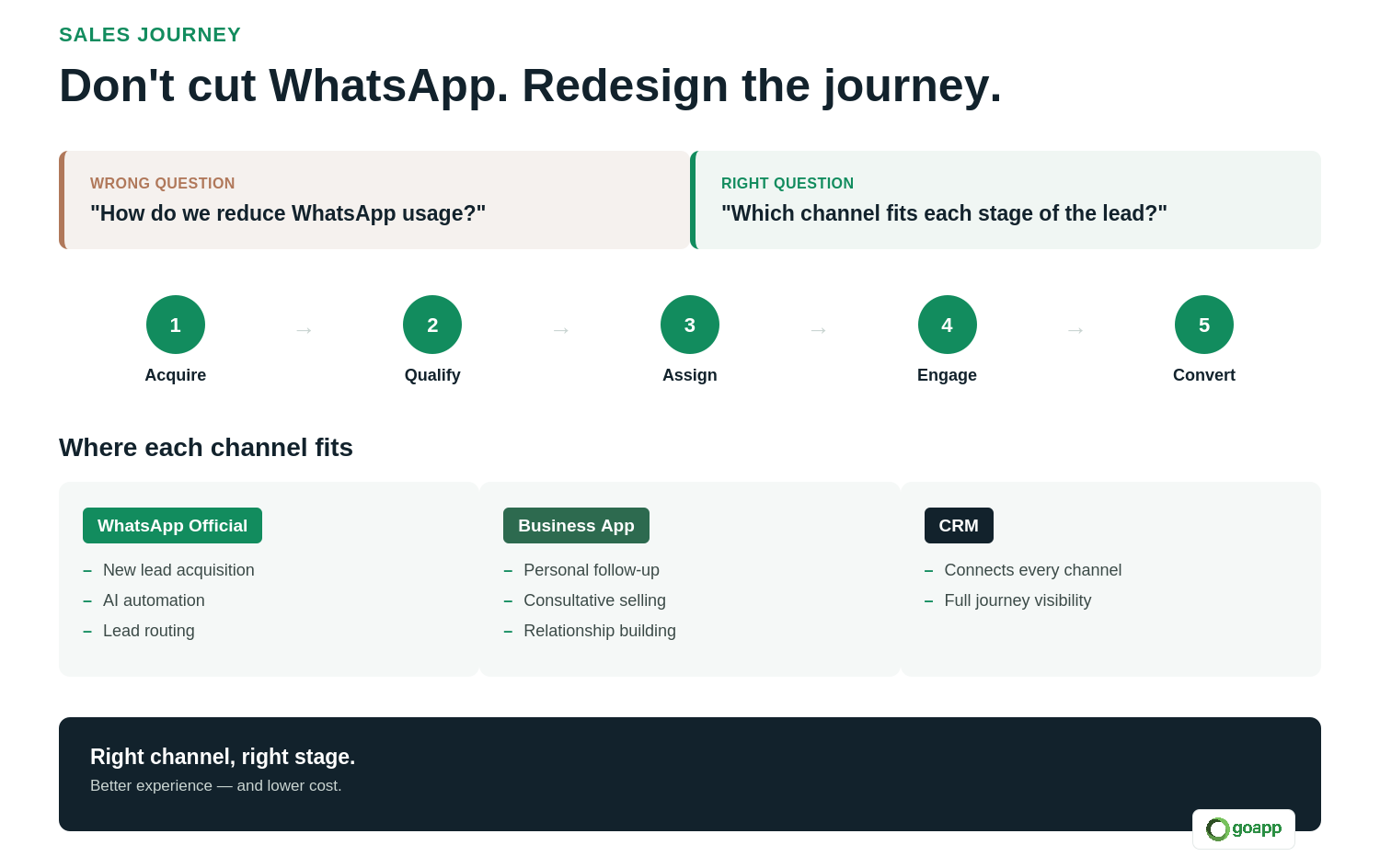
This pricing change should force a different question. Not:
"How do we reduce WhatsApp usage?"
But:
"Which WhatsApp channel should we use at each stage of the Lead?"
A better model:
Acquire → Qualify → Assign → Engage → Convert
Different systems should own different stages:
WhatsApp Official
Use it for:
Customer acquisition
Click-to-WhatsApp Ads
AI automation
Lead qualification
Lead routing
Structured customer journeys
WhatsApp Business App + Coexistence
Use it for:
Personal salesperson follow-up
Consultative selling
Negotiation
Long-running conversations
Relationship building
CRM
Use it to connect the entire customer journey into one Lead.
The WhatsApp Strategy Changes. Your CRM Needs to Change Too.
This creates a second challenge.
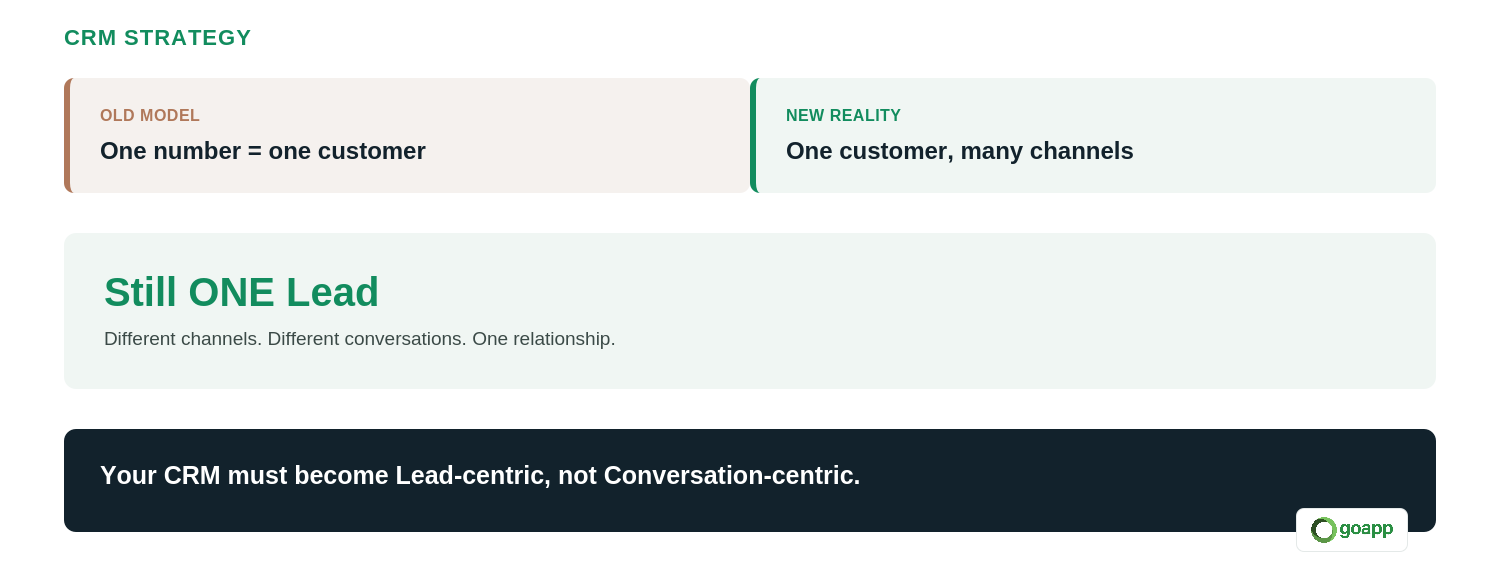
A traditional inbox system often thinks in terms of:
One WhatsApp number → One conversation → One customer
That model becomes increasingly inaccurate.
A customer may:
Enter through Click-to-WhatsApp Ads
Talk to an AI agent on your Official WhatsApp
Get assigned to a salesperson
Continue through that salesperson's CoEx number
Come back to the Official WhatsApp later
Have multiple conversations over several weeks
From the customer's perspective, this is still one relationship.
From the sales team's perspective, it should still be:
ONE LEAD.
Your CRM therefore needs to become Lead-centric instead of Conversation-centric.
1. Your Official WhatsApp number should be the main entry point for new Leads.
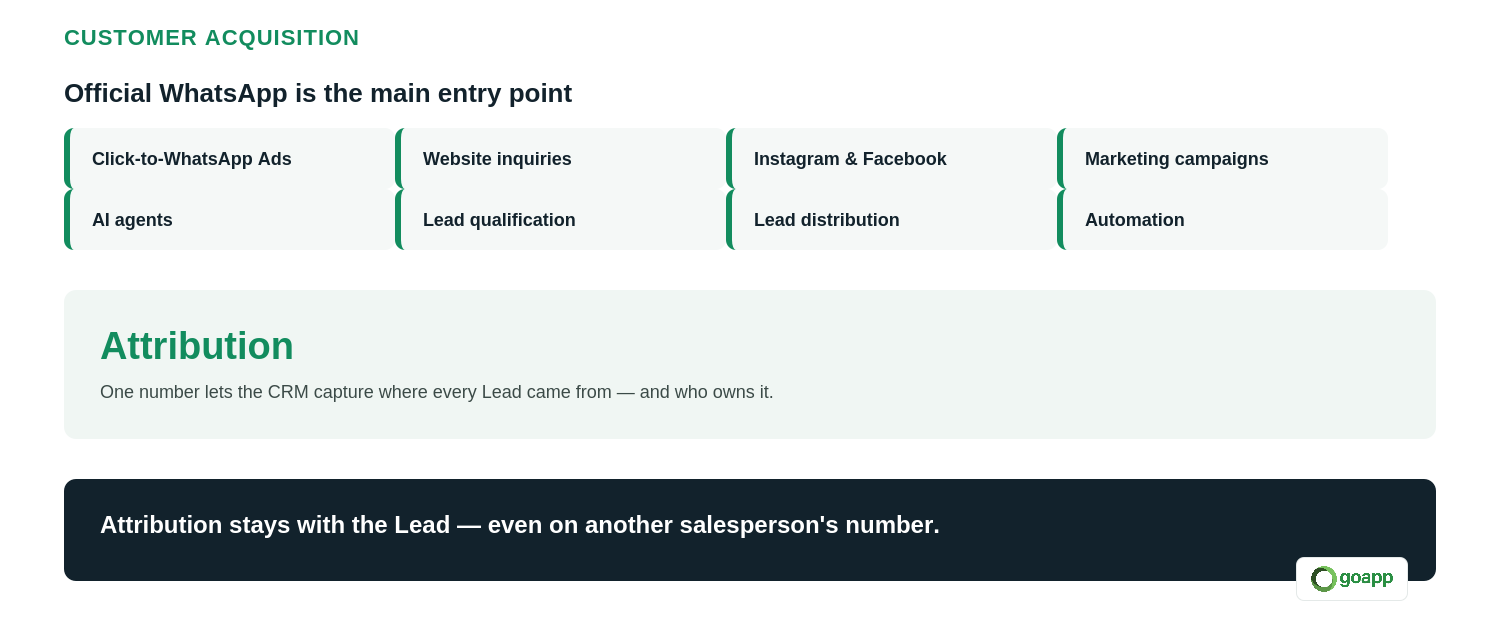
This includes:
Click-to-WhatsApp Ads
Website inquiries
Instagram and Facebook inquiries
Marketing campaigns
AI agents
Lead qualification
Lead distribution
Structured automation
Using one centralized Official WhatsApp number also helps maintain Attribution.
Your CRM should capture:
Campaign
Ad
UTM data
CTWA attribution
Lead source
Customer identity
Assigned salesperson
This information should stay attached to the Lead throughout the entire sales journey, even when the customer continues the conversation through another salesperson's WhatsApp number.
2. Turn the CTWA 72-Hour Window Into a Conversion Sprint
Click-to-WhatsApp should not only be treated as an advertising channel.
It should also be treated as a 72-hour conversion opportunity.
When a customer enters through CTWA, your CRM could display:
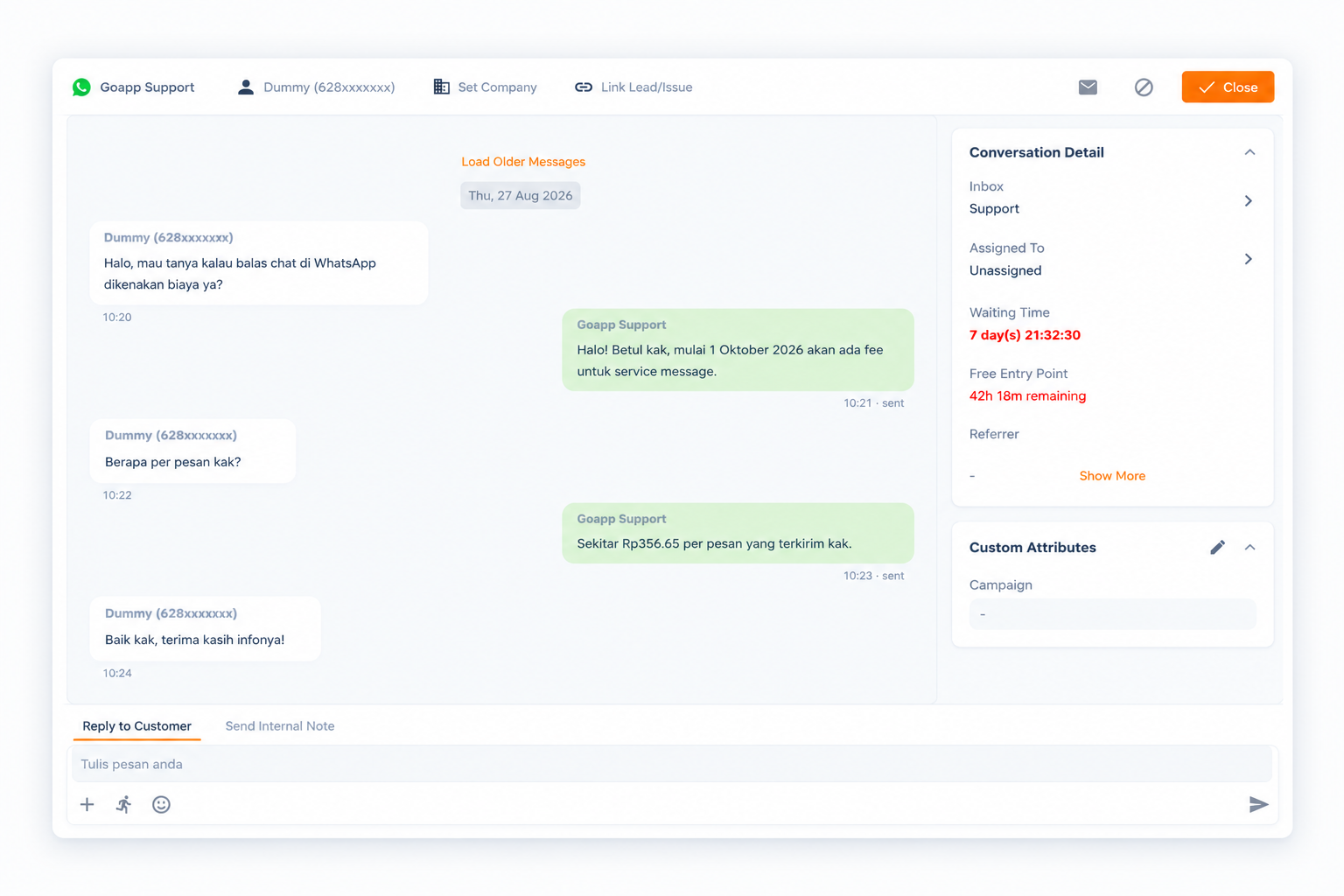
🟢 Free Entry Point - 42h 18m remaining
During this period, your system, AI, and sales team can prioritize the Lead and complete as much of the sales process as possible:
Understand customer intent
Answer questions
Qualify the Lead
Recommend products
Collect required information
Send brochures
Schedule meetings
Assign a salesperson
Follow up
Create an Opportunity
Close the sale
The objective is not to send more messages just because they are free.
The objective is to reduce delays while customer intent is high and communication cost is low.
3. Not every incoming inquiry needs to go directly to a salesperson.
AI can handle the early part of the journey:
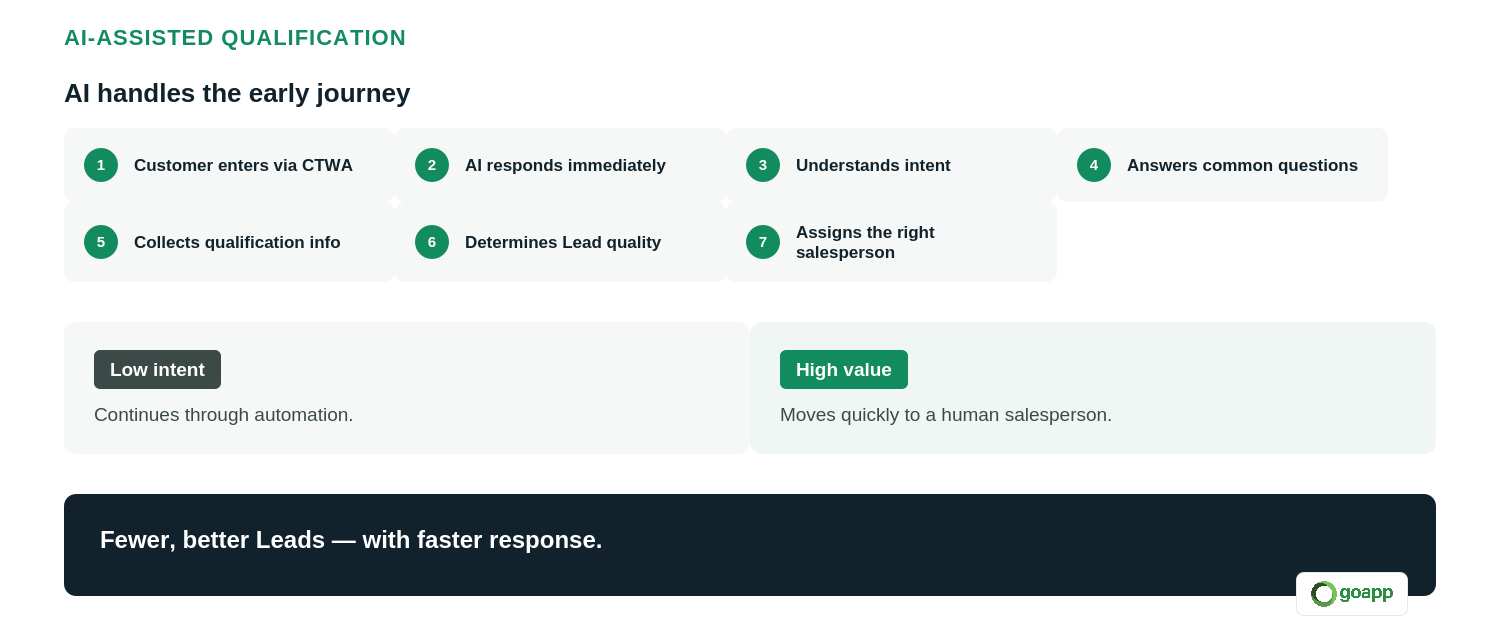
Customer enters through CTWA
↓
AI responds immediately
↓
Understand intent
↓
Answer common questions
↓
Collect qualification information
↓
Determine Lead quality
↓
Assign the right salesperson
A low-intent inquiry can continue through automation.
A high-value or qualified Lead can be quickly moved to a human salesperson.
This helps the sales team receive fewer but better Leads, while improving response time without requiring salespeople to monitor WhatsApp continuously.
4. Reduce Unnecessary API Replies
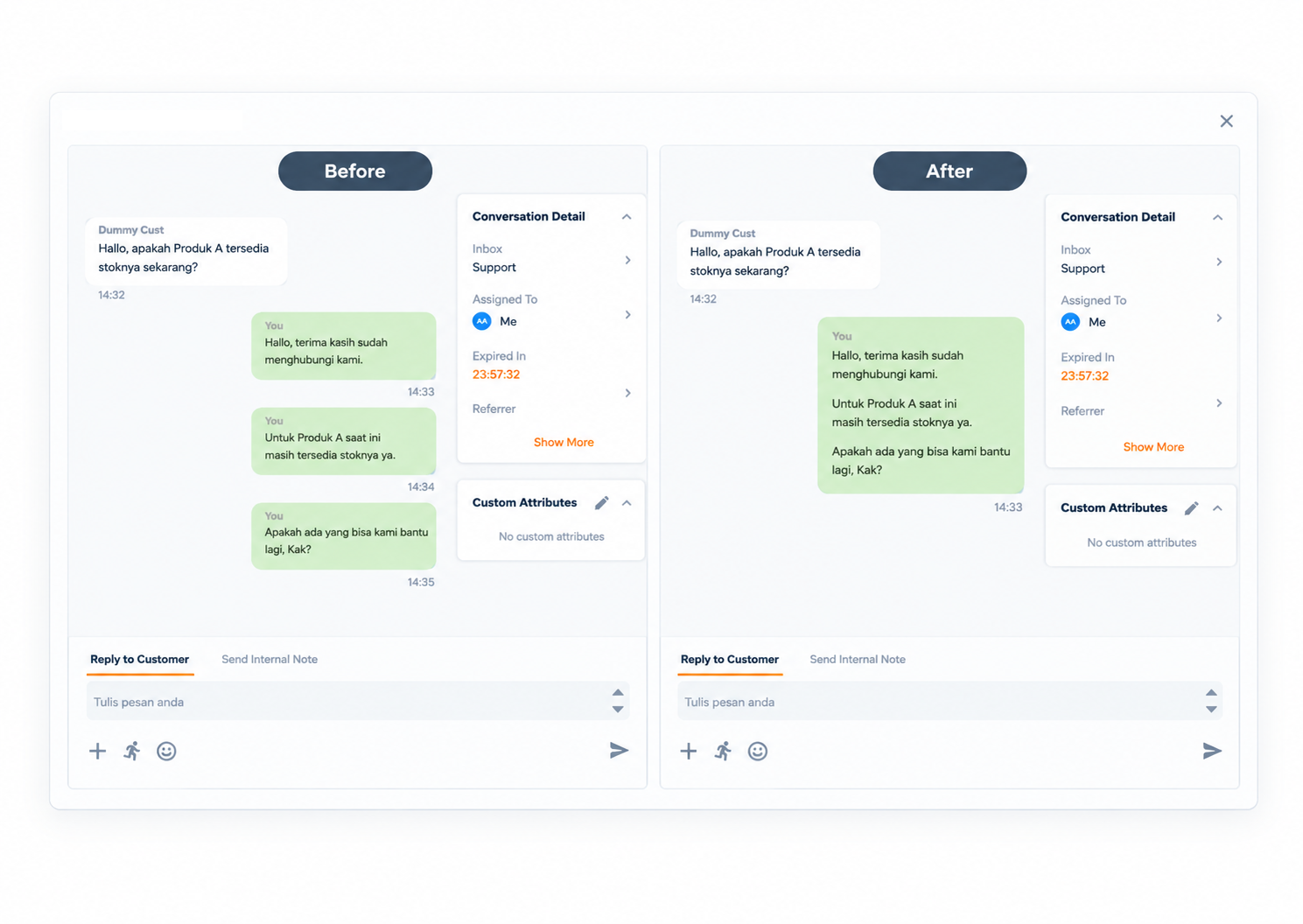
After October 1, conversation design will have a direct financial impact.
For example, a salesperson or bot may send:
Halo, terima kasih sudah menghubungi kami.
Untuk produk A saat ini masih tersedia stoknya ya.
Apakah ada yang bisa kami bantu lagi, Kak?.
What was previously a normal conversational style could now result in four separate billable messages.
Businesses should therefore encourage more useful and consolidated responses, rather than multiple short messages.
AI should also support message debouncing.
For example, a customer may send:
Hi
Mau tanya produk A
Stoknya masih ada tidak?
Instead of responding to each message separately, the system should wait briefly, combine the messages, understand the overall intent, and provide one relevant response.
This shifts the focus from message volume to business outcomes.
The key metric should not only be:
Number of messages sent
It should increasingly become:
How many messages were required to qualify, resolve or convert the Lead?
5. Move Longer Human Follow-Up to WhatsApp Coexistence
Not every sale can be closed within 72 hours.
Some customers require several days or weeks of:
Consultation
Negotiation
Quotation revisions
Internal approval
Relationship building
Follow-up
This is where WhatsApp Coexistence becomes especially valuable.
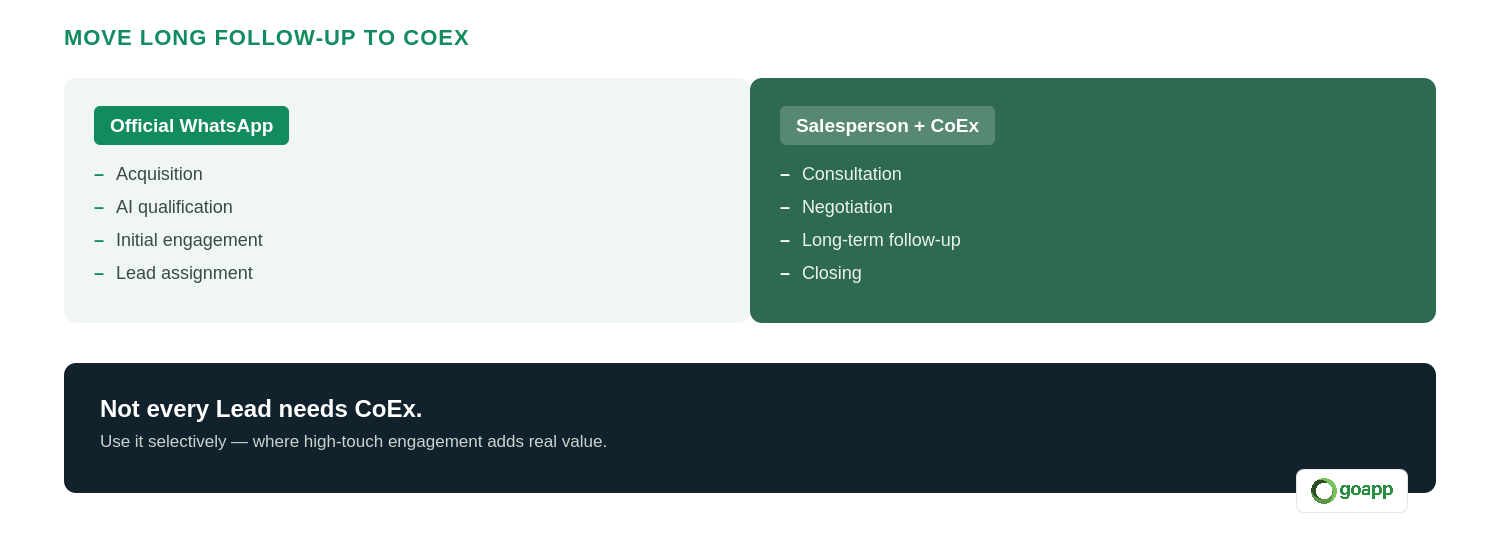
Salespeople can continue communicating directly through the WhatsApp Business App on their device, while the business maintains the number's connection to its system.
The objective is not to move every Lead to CoEx.
CoEx should be used selectively, specifically where high-touch human engagement actually adds value.
6. Make the Lead the Source of Truth
Example: a customer first messages PT Dummy Goapp, then continues with salesperson Goapp Support on his own number. Technically that's two conversation rooms — but the CRM should keep one Lead record.
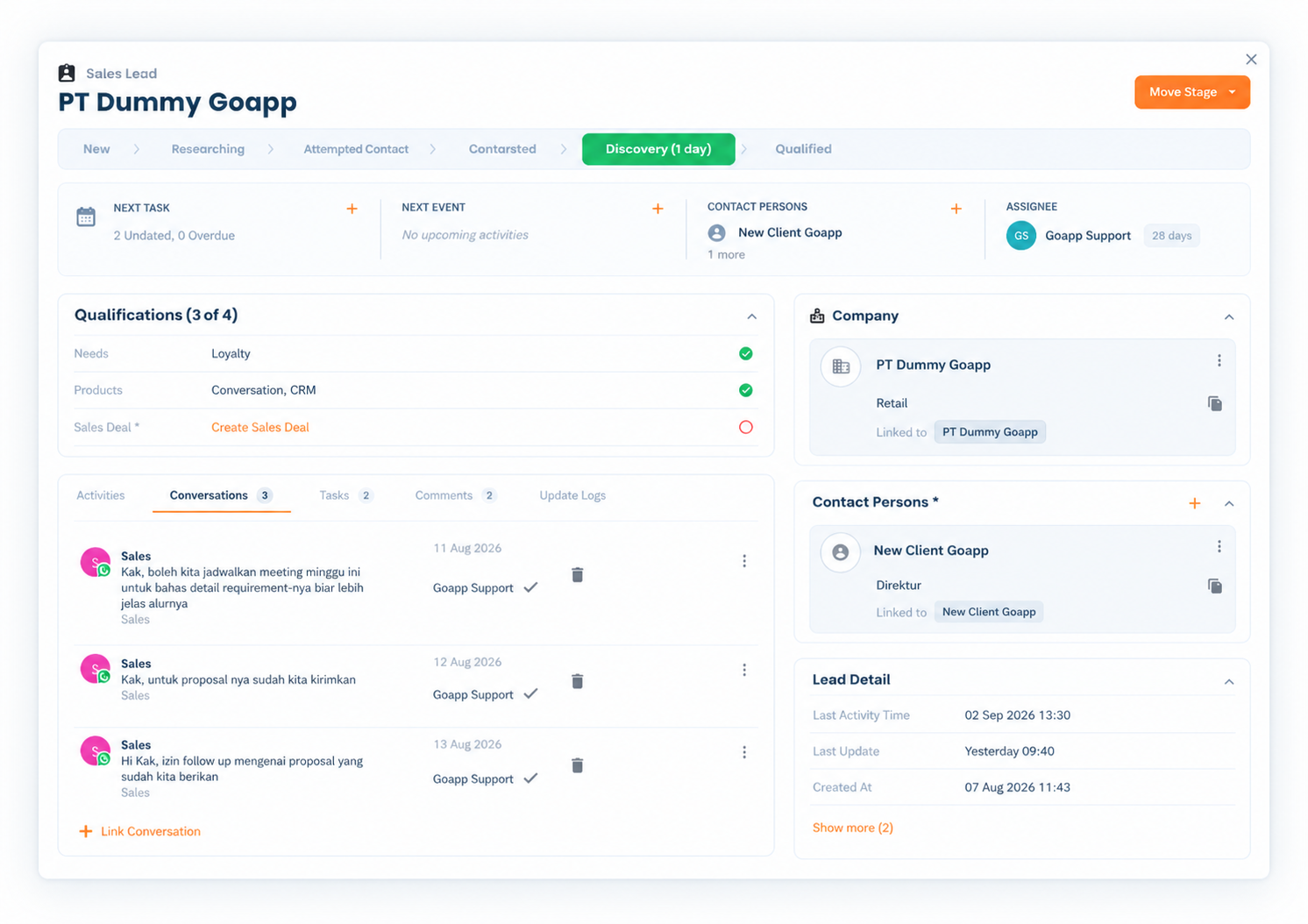
Lead #LEAD-48291
Customer: New Client Goapp
Company: PT Dummy Goapp
Owner: Goapp Support
Stage: Discovery
Needs: Loyalty
Products: Conversation, CRM
Connected Conversations
Official WhatsApp — acquisition + AI qualification
Goapp Support's CoEx WhatsApp — personal sales follow-up
The channel changed. The Lead didn't. The Lead should become the source of truth, not the conversation room.
7. Automatically Create or Match Leads From CoEx
Not every Lead arrives through your Official number — prospects sometimes contact salespeople directly, or salespeople start the relationship themselves.
Your CRM should detect these conversations:
Search existing Contact → search existing Lead → search existing Company.
If found, link the conversation to that customer. If not, create a new Lead, auto-assign the salesperson, and start tracking the journey.
This solves a common problem: your CRM might show 5,000 Leads while your team's WhatsApp accounts hold another 2,000 untracked prospects. You shouldn't run two separate customer databases — your CRM, and your salespeople's phones.
8. Create One Unified Lead Timeline
Managers shouldn't have to read multiple WhatsApp threads to understand what's happening. The Lead timeline should show the key events across the whole journey.
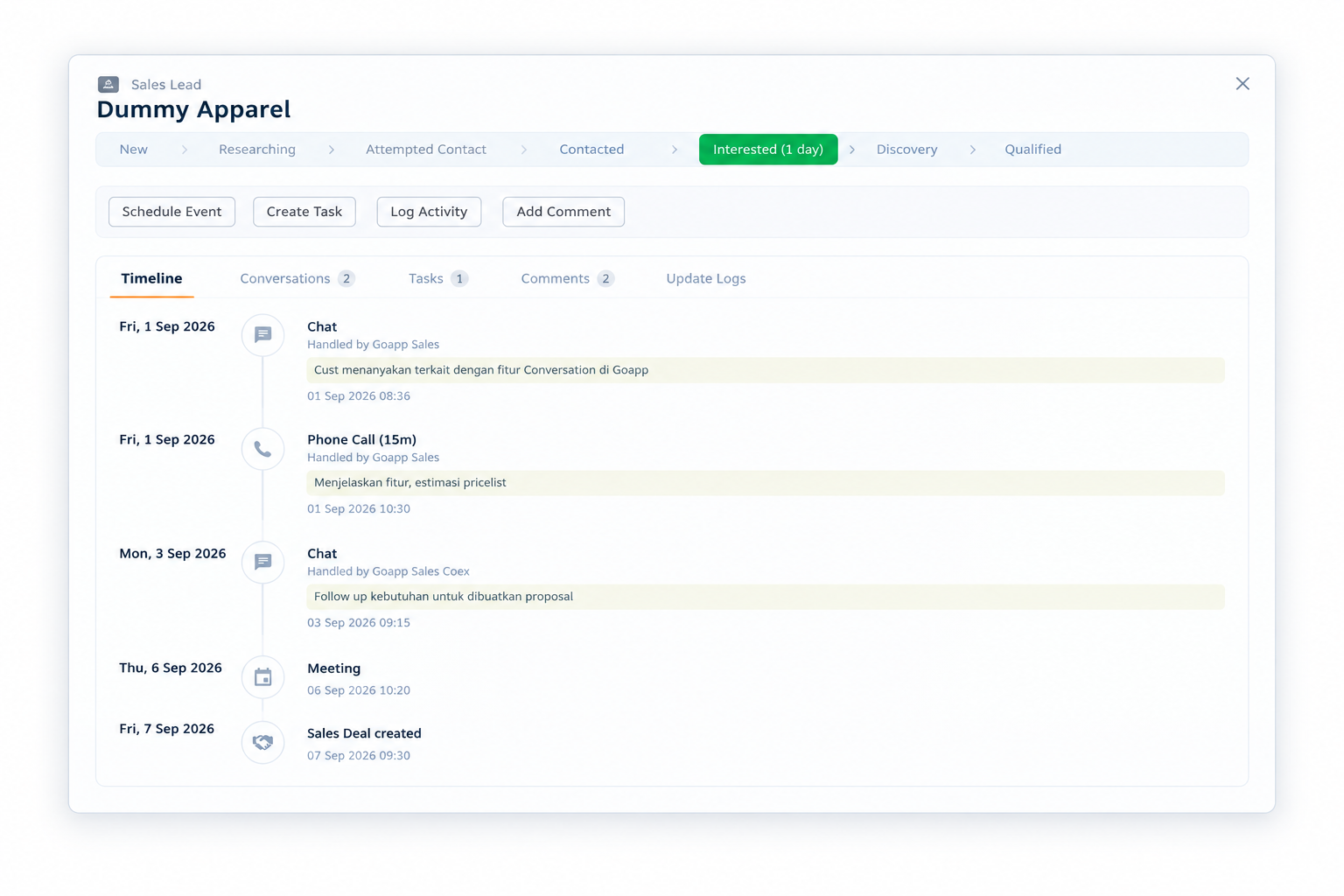
For example:
Day 1
08:36 — Customer chat, asking about Goapp's Conversation feature
10:30 — Phone call (15m), explained the feature & pricelist estimateDay 3
09:15 — Follow-up chat by Sales CoEx, requirement for a proposal
15:00 — Proposal sentDay 6
10:20 — Meeting heldDay 7
09:30 — Sales Deal created
It should combine chats, calls, meetings, notes, tasks, events, quotation activity, stage changes, and deal activity. The channel can change repeatedly but the Lead timeline stays continuous.
9. Don't Put Every WhatsApp Message Into the Timeline
A unified timeline doesn't mean dumping hundreds of raw messages into CRM activities, that makes it unusable.
Separate:
Conversation
The full WhatsApp message history.
Activity
A meaningful summary, example:
“Sales consultation via WhatsApp — Customer is interested in Business Internet for a new BSD branch. Target installation in October. Budget Rp8–10 million. Requested proposal.”
Next Action
“Send proposal tomorrow.”
This gives managers what they need without reading every message.
10. Use AI to Maintain One Lead Summary Across All Conversations
AI is far more useful working at the Lead level not only the conversation level. Instead of separate summaries for the Official and CoEx threads, it should maintain one evolving summary.
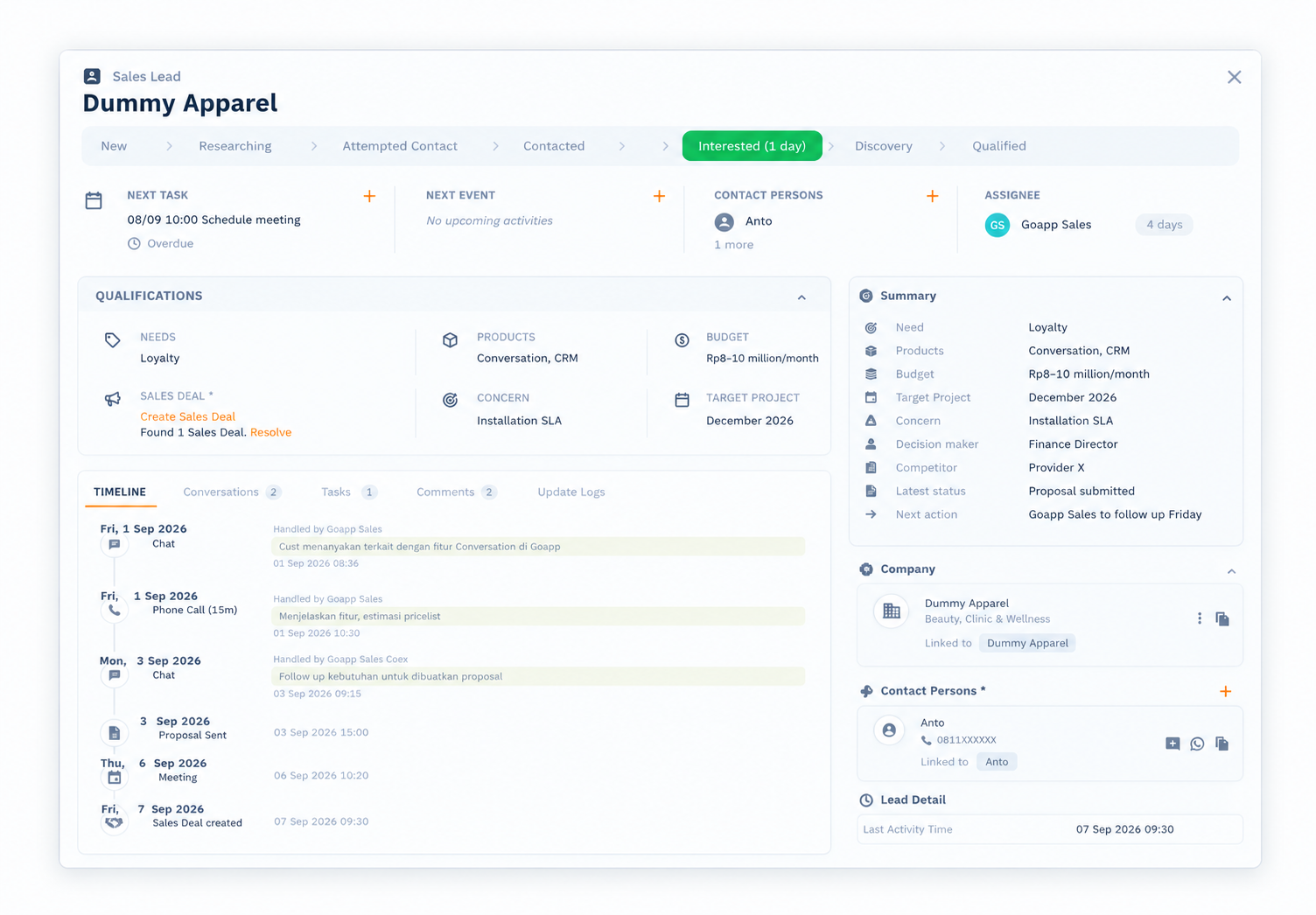
AI Lead Summary
Need: Loyalty
Products: Conversation, CRM
Budget: Rp8–10 million/month
Target Project: December 2026
Concern: Installation SLA
Decision maker: Finance Director
Competitor: Provider X
Latest status: Proposal submitted
Next action: Goapp Sales to follow up Friday
The AI updates this using Official WhatsApp, salesperson CoEx, meetings, calls, and sales notes. So a manager can understand a complex Lead in seconds instead of rereading hundreds of messages.
11. Let CRM Understand WhatsApp Cost
Salespeople shouldn't need to memorize Meta's pricing rules, the CRM should.
For every Lead, the system can track which number is in use, whether it came from CTWA, when the 72-hour window expires, whether the 24-hour service window is open, remaining free messages, whether the next message would be chargeable, and whether a CoEx channel is available.
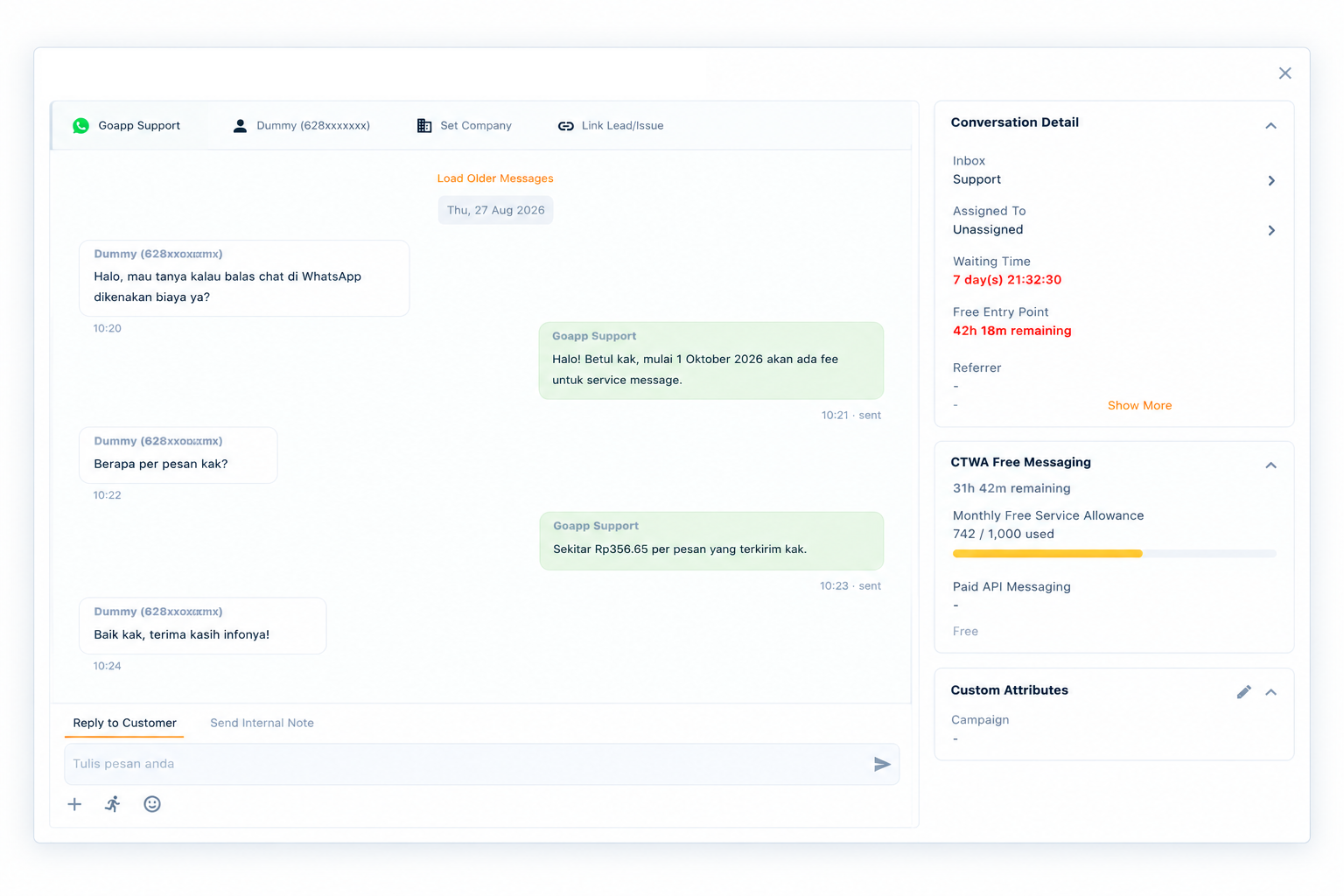
Then the system can show simple status:
🟢 CTWA Free Messaging
31h 42m remaining — Recommended: continue engagement now.
🟡 Monthly Free Service Allowance
742 / 1,000 used
🔴 Paid API Messaging
About Rp356.65 per service message — Recommended: continue personal follow-up through Andi's CoEx.
Pricing complexity becomes the system's problem, not the salesperson's.
12. Move Qualification Into the CRM, Not the Chat
WhatsApp tells you what the customer said; the CRM should tell you where they are in your sales process. Each Lead should carry structured qualification data like: need, product interest, budget, timeline, concern, lead quality. AI can extract and suggest this from conversations, but it should live on the Lead itself.
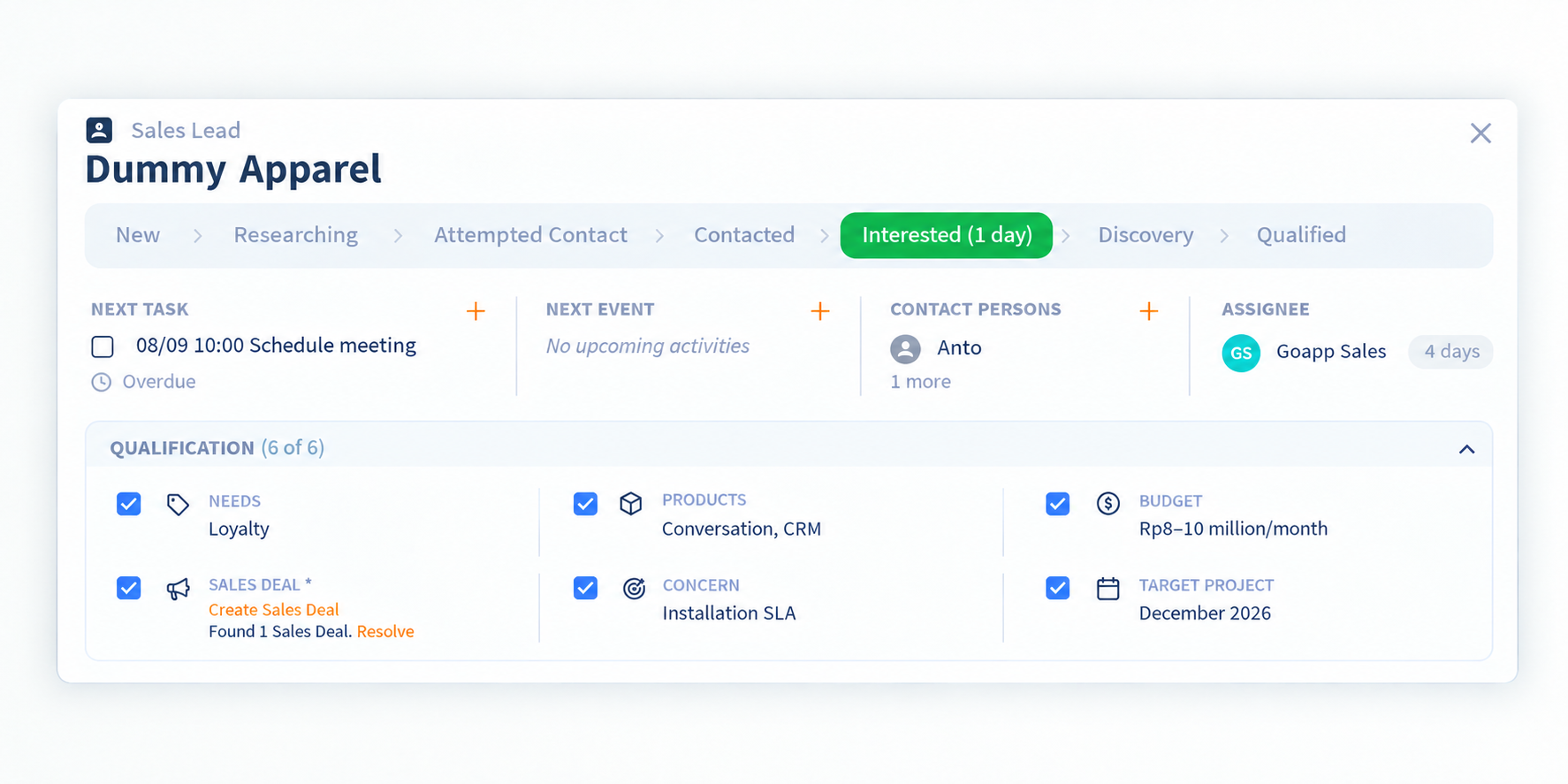
New → Researching → Attempted Contact → Contacted → Interested → Discovery → Qualified.
That way, switching WhatsApp numbers never resets the sales process.
13. Measure Leads, Not Conversations
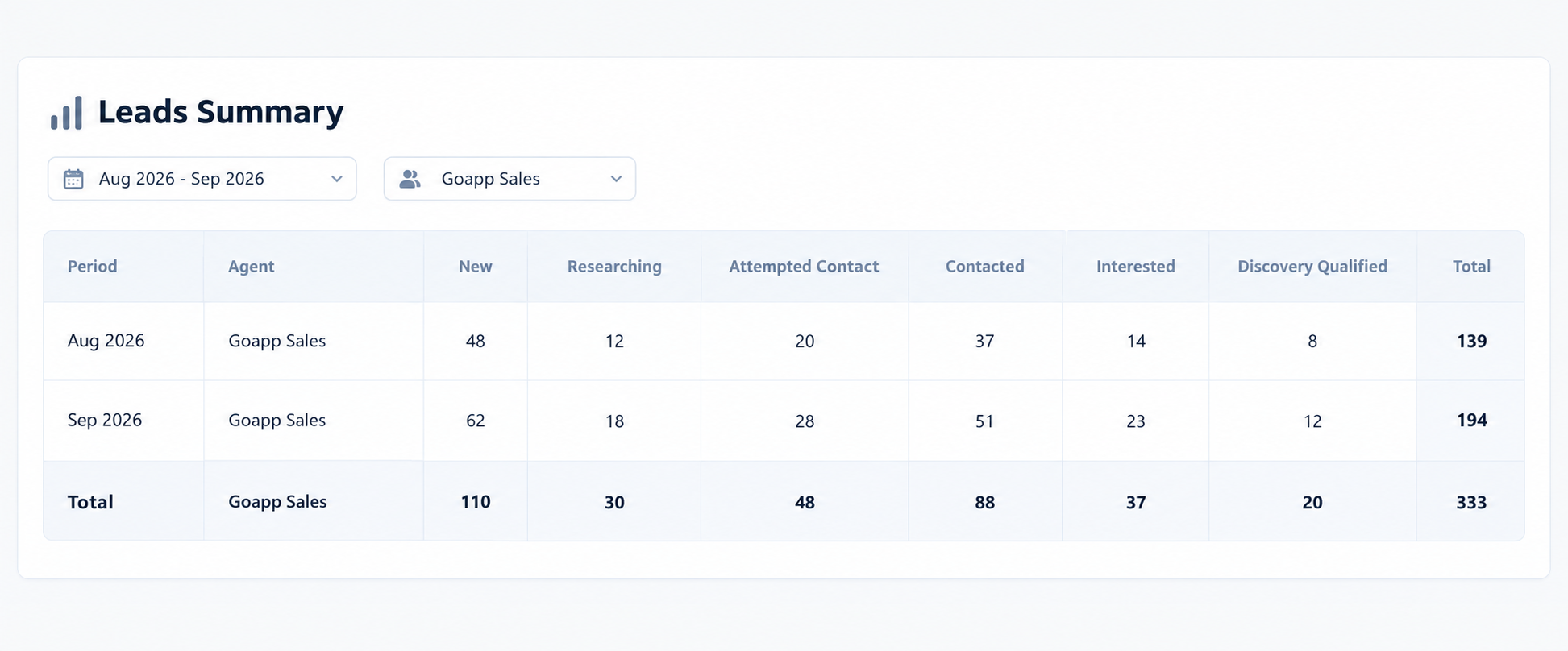
This should also change your reporting. Messages sent, conversations handled, and average response time are still useful, but sales management needs to look further down the funnel:
New → Leads generated
Researching → Still researching needs
Attempted Contact → Contact attempts made
Contacted → Successfully reached
Interested → Showed interest
Discovery Qualified → Passed initial qualification
Business Outcome — Revenue
And WhatsApp economics should connect to that funnel. Track cost per Lead, per Qualified Lead, per Opportunity, per Deal, messages per Lead, share of messages sent in CTWA free windows, CTWA conversion rate, CoEx handoff and conversion rates, response time, follow-up compliance, conversion and revenue per salesperson, and revenue attributed to CTWA.
The question shouldn't only be:
“How much are we spending on WhatsApp?”
It should become: “We spent Rp15 million communicating with Leads through WhatsApp. How much pipeline and revenue did that generate?”
14. Add Proper Governance for Salesperson WhatsApp Numbers
For businesses with 50, 100+ salespeople, there's an operational risk. If customers talk to salesperson numbers directly, those relationships need to stay company assets.
Businesses should consider governance around:
Number ownership
Company-controlled numbers where practical
Salesperson onboarding
Salesperson offboarding
Customer reassignment
Lead ownership
Access control
Conversation synchronization
Audit history
Device management
You don't want a salesperson leaving the company and taking years of customer relationships with them.
CoEx deployment at scale can also create additional Meta account and asset-management requirements, so onboarding architecture needs to be considered as part of the solution.
The New WhatsApp Sales Architecture
Put everything together and the new model looks like this.
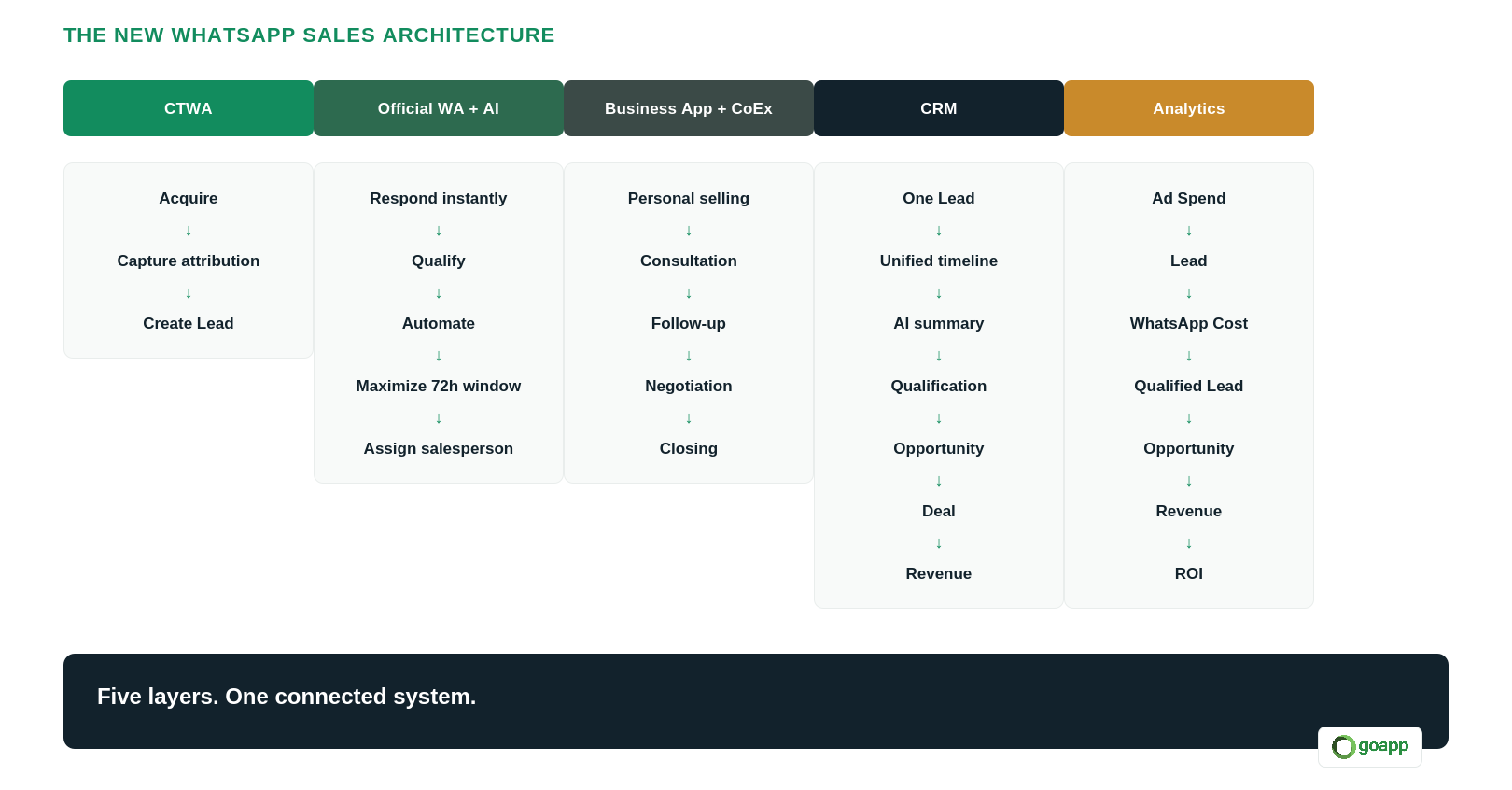
CTWA
Acquire → capture campaign attribution → create Lead
Official WhatsApp + AI
Respond instantly → qualify → automate → maximize the 72-hour free window → assign salesperson
WhatsApp Business App + CoEx
Personal selling → consultation → follow-up → negotiation → relationship building → closing
CRM
One Lead → multiple WhatsApp conversations → unified timeline → AI summary → qualification → tasks & events → Opportunity → Deal → Revenue
Analytics
Ad Spend → Lead → WhatsApp Cost → Qualified Lead → Opportunity → Revenue → ROI
The Goal Isn't Simply to Save Rp356 Per Message
Meta's October 2026 pricing change will push many businesses to rethink how they use WhatsApp but cutting cost is only the starting point. The bigger opportunity is redesigning the whole customer journey:
Use Official WhatsApp for acquisition, automation, and attribution.
Maximize the CTWA 72-hour free window while intent is high.
Use AI to respond, qualify, and route Leads faster.
Use WhatsApp Business App + CoEx for longer, high-touch selling.
Use CRM to connect every conversation into one Lead and one journey.
Measure success all the way from acquisition to revenue.
The payoff isn't only a lower WhatsApp bill, it's faster response, better Lead distribution, fewer wasted conversations, more disciplined follow-up, clearer customer visibility, better marketing attribution, higher salesperson productivity, higher conversion, and more revenue.
The future sales stack shouldn't be:
“WhatsApp API vs. WhatsApp Business App.”
It should be: “WhatsApp Official + WhatsApp Business App + AI + CRM — each doing the job it does best.”
Want us to tear down your customer journey?
30 minutes. We look at how you're acquiring customers and where you're losing them, from ads and WhatsApp leads to CRM follow-up, repeat purchases, and loyalty. You'll leave knowing what to fix first.